
Sauna is a room or a separate small wooden house that is heated up for people to sweat as recreation. In most cases – but not always – sauna use includes vapour production by pouring water on the hot stones and also washing.
Saunas have thousands of years of history especially with the Nordic nations. Several sauna types have been developed in history by the various groups of people. Therefore the definition of sauna cannot be unambiguous and – especially in case of sauna using nations -various hybrid types have been developed. In case the type is not specified below we are talking about the most known type the Finnish sauna.
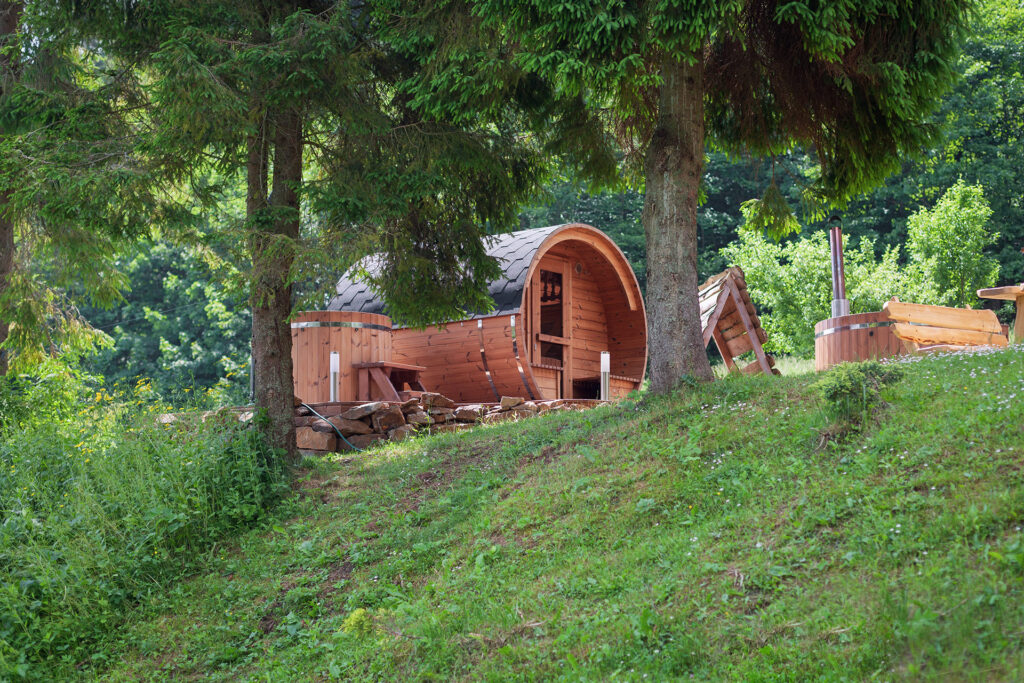
Nordic nations have known the sauna most likely for 2000 years, however the first written records reach back only 1000 years. Originally it was a room for washing, bathing and since generally it was a clean room with clean water, it was used for child deliveries and for curing sick people. Older Finnish people say even today that they were born in a sauna.
It is challenging to say the date of its first appearance, since the definition of sauna is not clear and there have been many different transitional types. Is a hot room enough or is the presence of hot stones and steam creation also essential? In case we accept the latter, then many of the presently used saunas are also left out of the category. Migrant Nordic nomads already had primitive saunas. They dig holes in the ground, made fire in them, closed the hole from above to make a place suitable for bathing. Most likely they used open fire and people had to wait until the fire was off or was smouldering only before they could use the sauna. The inipi of the Indians is very similar to this.
The Finnish word “sauna” is truly ancient, with no known etymological antecedent, likely it was used to describe the before mentioned digged bath. This hot room later developed into smoke sauna, that is the most traditional type of Nordic saunas.
Saunas today
WiseHus Manufacture has been established with the mission to make the lifestyle of using a home premium sauna more popular. Our initial main activity was the production of Finnish saunas and OUTDOOR saunas. Today however we are proud to say that we play an important role in the introduction of sauna culture to Hungary with the designing and general construction of unique Finnish saunas, Outdoor saunas, combined saunas, Wellness units as well as premium quality outside saunas and sauna houses.
HOT TUB
The earliest hot tubs were calderas in which hot stones were placed to heat the water.[citation needed] Therma in Ikaria has been a very popular place particularly for hydrotherapy ever since the 4th century BC. The remains of wrecked marble bathtubs along with a pre-historic aqueduct that have been unearthed from this area bear ample testimony of the place’s popularity in the ancient times.
In 737 A.D., Japan’s first onsen opened near Izumo, Shimane, and centuries later the first ryokan (inns) were built, offering food, accommodations, and soaking tubs called ofuro.
In ancient Rome there were three types of baths: baths at home (balnea), private baths (balnea privata), and public baths (balnea publica). The practice of bathing was so engrained that the Roman legions, during their long occupations in foreign lands, built their own baths at mineral and thermal springs in the newly conquered lands. Examples are found all over Europe.
After the fall of the Roman Empire in 476 and the rise of Christianity, cleanliness was abandoned since the Church considered that the practice of bathing a prelude to forbidden behaviour.[4] At Cluny custom required monks to take a full bath at Christmas and Easter.[5] Private bath-rooms in castles, such as the one at Leeds, could often accommodate multiple bathers.[6] From the 13th century onwards, baths gradually came into re-use, particularly in southern Europe under the influence of the Moors.
In the 1940s hot tubs began to appear in the US, inspired by the Japanese ofuro. Hydrotherapy pumps were introduced by Jacuzzi. Fiberglass shell hot tubs appeared around 1970 and were soon superseded by cast acrylic shells.
A sauna from the book of Accretes: entitled “Travels”,(1802) According to the writings of the 17th century the stranger visiting the Scandinavian countries was “let into the room heated up to 90-100 degrees Celsius and as a display of utmost respect and honour he was allowed to totally undress and he was even promised that he would be whipped with birch tree sticks soon afterwards. The visitor receiving this treatment of utmost grace usually tried to flee at this stage saying something that he does not wish to receive this kind of special hell-like hospitality.” In other parts of Europe it took a far longer period of time for people to realize what they were missing. Saunas of old times were rooms with multiple functions. They were not only used for washing but also for drying meat as well as for other agricultural activities. It was also a place for curing: it was not only used as a tool for natural healing, but the doctor or charlatan also practised in the saunas. In case of the charlatan, the dark sauna contributed to the establishment of the mystic atmosphere. Saunas therefore were ritual locations, according to Finnish customs the probability of maiden girls to be taken was “increased” with a special sauna ceremony held on midsummer night (juhannuspäivä); an old lady kept saying magic things in the scent of poplar leaves and other plants.
Taken from the Swedish travel diary of Ur Lorenzo Magalottis (1674, Florence manuscript)
Until the beginning of the 20th century smoke sauna was the only sauna type. Its disadvantage is that heating up takes a lot of time, it is difficult to keep clean and it is more flammable. During the 20th century as a result of the industrial revolution, public saunas appeared in cities that were equipped with chimneys. After people took a liking of these places, they started to build similar saunas in the mökkis (generally lakeside, weekend holiday homes). In most cases a new one was erected simply besides the smoke saunas. Smoke saunas still remained out there for a period of time then they were dismantled after not being used and becoming rotten. In some places they are still present as a result of poverty or for tradition. A transitional type of sauna was the chimney sauna where the chimney was not a separate unit, but the smoke was released through the stones into the chimney. This solution did not solve many of the disadvantages of the smoke sauna: use was only possible after the fire was gone. The separate chimney solution was introduced in the 1930’s.